
By alphacardprocess April 1, 2026
The nature of emergency plumbing scenarios requires considerably rapid action and response. Illustrated within the context of a plumbing emergency, a leaking pipe could cause extensive damage if not attended to immediately, as could the situation of a commercial water heater breakdown or sewer backup. So it becomes more important for plumbing companies to pre-autorize emergency jobs before parts and after-hours labor are added.
Naturally, customers expect plumbing professionals to respond without lengthy explanations or concerns regarding payment. However, for plumbing professionals, the inability to act without a customer agreement creates a kind of emergency of its own. These include disputes over a closed invoice, the payment of which has been delayed, and a customer who claims they never consented to the invoice total.
Hence, the significance of pre-authorizations for emergency jobs.
Table of Contents
Fulfilling a revenue commitment to the company through prompt customer engagement is paramount to a plumbing company. This is achievable through developing an effective emergency job pre-authorization. This is further complemented by a commitment to the customer by developing an effective pre-authorization system. This allows the customer to authorize the potential expenses involved in the plumbing job and prevents the plumbing professional from having to justify costs retroactively.
In the following sections, the objective is to summarize means through which plumbing professionals can create a system for developing pre-authorizations on emergency jobs that are simple and fast.
The Difference an Emergency Job Warranty Could Make

The nature of an emergency service call is fundamentally different from that of a routine service appointment. An emergency call does not afford the professional the time to assess the situation, create an estimate, or provide an explanation and scope of the job. The primary objective is always damage control.
Unforeseen variables often make emergency jobs difficult to estimate. While a technician may understand a problem, he may not yet know:
- If a standard or special part is needed
- How much additional access-related labor will be required
- If upgrades related to current code will be needed
- If repairs will need to be done during nights, weekends, or holidays
- If both temporary and permanent repairs will be done
Without pre-authorization, a plumbing company is financially risking every job done under pressure. While a customer may approve emergency work verbally, they may question pricing on the invoice for after-hours labor, materials, and additional hours. Unclear approval stems conflict, even where work was required, most times in emergencies.
In emergency situations, pre-authorization is essential to have most of the work done while keeping the customer informed of most situations and variables outside their provided approval.
What Pre-Authorization Emergency Jobs Means in Practice
Pre-authorization isn’t the same as fixed final quoting. Pre-authorization is a customer-approved document that allows a company to:
- Immediately send and start emergency work
- Do any required diagnostics and stabilization work to preserve safety
- Charge for emergency labor or initial work as agreed
- Work within a defined budget set by the contractor
- Do materials, extras, and after-hours work under disclosed, agreed parameters
Pre-authorization ensures you have permission and clarity to act quickly.
A well-structured pre-authorization should clarify that the estimated charge is for the urgent response and initial work only, and that final costs may increase due to parts, accessibility, labor, time, and scheduling. This gives an honest look at the entire process. Customers don’t feel taken advantage of, and your team doesn’t feel vulnerable.
The Core Issue: Unforeseen Costs During Emergencies
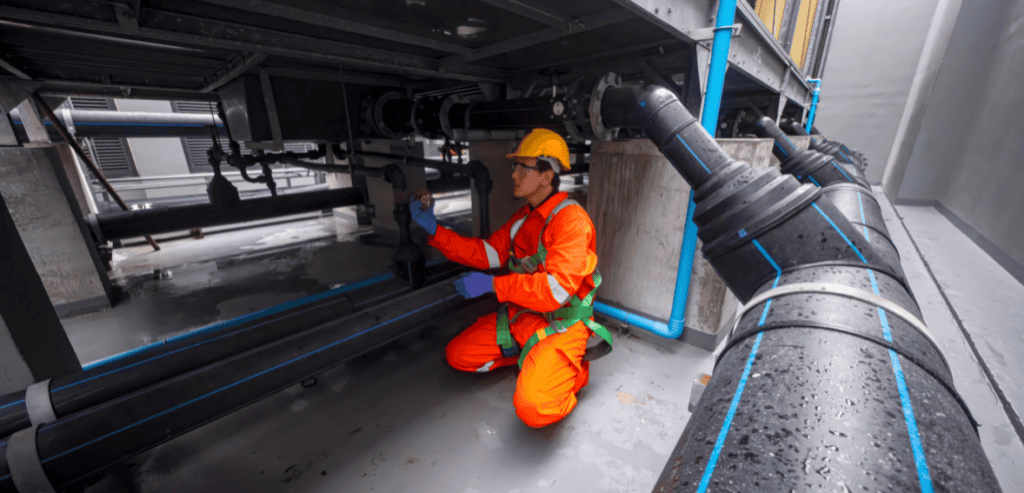
Initial urgent plumbing jobs always start with an incomplete picture. This uncertainty is not a failure of preparation. It’s a fact of the work.
Consider, for example, a technician addressing a burst pipe. The only thing they know at that point is that they will need to turn the water off and isolate the problematic line. Once they open the wall, or remove damaged fittings, a myriad of new situations could arise, such as:
- Other corroded pipe sections that need to be replaced
- Pipes and fittings of non-standard dimensions or obsolete configuration
- A leak source that is concealed and outside the failure point that was visible
- Water damage that requires a more extensive repair
- Access issues that increase the required labor time
This is also the case for blocked drains, slab leaks, failed water heaters, outages of commercial restrooms, and sewer emergencies. Early assumptions are often incomplete.
A plumbing company is damned if they do not have full certainty before seeking approval, as they will lose time. If they start the work without a clear mandate, disputes over invoicing are almost guaranteed. The answer is not to impose a limit too early. The answer is to design approval stages.
Advantage of Emergency Job Pre-Authorization
When done right, pre-authorization enhances both operational and customer experience.
Faster Dispatch and On-Site Action
The on-site team and office staff can act more decisively due to the customer’s agreement with the emergency response framework. This minimizes delay and shifts the focus to resolving the problem.
Fewer Invoice Disputes
Customers push back less when they have been informed about additional charges for parts, materials, and after-hours work. Disputes arise from surprises and expectations.
Better Cash Flow Protection
The emergency services undertaken are usually outside standard hours, which increases labor and parts costs. With pre-authorization, the documented approval supports the merit of the costs incurred.
Stronger Professional Image
A business that clearly outlines emergency billing appears organized and credible. While the situation may be stressful for the customers, they appreciate a professional touch.
Better Communication Between Office and Field Teams
Pre-authorization in emergency cases improves communication by providing dispatchers, CSRs, and technicians a common reference point that reduces confusion and misunderstanding.
What Should Be Included in an Emergency Pre-Authorization

A pre-authorization script or form should be simple for quick use while providing sufficient detail to safeguard the business. The key elements to include are as follows.
Acknowledgment of Emergency Services
Clearly state that the customer is inquiring about emergency plumbing services and understands that work may commence before the full scope of the work is determined.
Initial Charges
Before parts and extensive labor are added, describe any immediate charges that apply. This may include:
- Emergency Dispatch Fee
- Diagnostic Fee
- Minimum Service Call Charge
- Initial Labor block, such as the first hour
This builds a foundational financial contract prior to the technician commencing any work.
After-Hours Labor Disclosure
If the call occurs at night, on weekends, or on holidays, explain that after-hours labor rates apply. This should be plainly stated–not in the fine print.
Parts and Materials Disclaimer
Make it clear that parts and/or materials are excluded in the initial preauthorization, and those will be added as needed to finish the job.
Spending Threshold
Many plumbing businesses use a “not to exceed without further approval” amount to their advantage. For example, the client may approve emergency work to a certain dollar amount, after which further approval is required.
This allows both parties some room. The technician is free to act within reason, and the client retains control over larger amounts.
Authorization Method
Clearly document how approval is obtained. This can be:
- Signed Digital Document
- Text Message
- Legally record audio approval
- Signature on Tech’s Mobile Device
- Tech’s Device Signature
This allows for a clear record should it be needed later.
Customer Responsibility Statement
State that customers are liable for the charges related to labor, materials, emergency response, and any additional work performed on-site that is approved.
How to Explain It Without Being Pushy
Most plumbing companies avoid introducing pre-authorization due to the fear of being too overly transactional at a stressful moment. Customers appreciate clear communication, especially during stressful situations.
The most important part is the tone.
Instead of being defensive, approach pre-authorization as the first step to starting to help the customer, while also keeping the billing part clear. For example, your team should explain to the customer that for emergency jobs, there may be additional parts and/or labor that cannot be determined until the technician evaluates the issue. Therefore, the company needs to get pre-authorization to start the work and manage the customer for additional charges that will be beyond the agreed amount.
That is reasonable because it is reasonable. It provides urgency, honesty, and process.
Emergencies do not expect perfection. They have communication as an expectation.
Guidelines for Plumbing Companies
Pre-authorization is built into your workflow and works best when it is pre-planned instead of being a last-minute decision for each call.
Standardize Your Script
Your staff should have the same explanation every single time. Standardized scripts minimizes inconsistencies and aids the customer in quickly grasping the process. In addition, it protects your brand by the professionalism of the communication.
Digital Approval Tools
Real-time pre-authorization capture is facilitated by digital and mobile approval forms. They also provide a timed record to help with any questions about billing that may arise later.
Educate Technicians to Verify Changes in Scope
The first authorization is not the last sign-off. If the technician sees a more extensive issue, more expensive parts are required, or significantly more labor is expected, they should put the job on hold and seek approval to go beyond the original scope.
Stabilization and Full Repair Should Be Separate
In some emergencies, the top priority is control, not complete resolution. Make the distinction clear. Customers may opt to pre-authorize emergency stabilization first and then give the go-ahead for full repair once the system is safe and the entire scope is better understood.
Use Plain English
When communicating with customers, avoid legalese. Your form can be as formal as necessary to protect the business, but the conversation should be straightforward.
As the saying goes, “Document, document, document.”
The more extensive the documentation, the more protection you have in the event of a nonpayment dispute. Note the time of dispatch, time of arrival, what you found, what approvals you received, what parts you used, how many hours of labor you billed, and what decisions the customer made regarding continuing or postponing the work.
Emergency pre-authorization flow
A reliable emergency approval process typically adheres to the same pattern every time.
Step 1: Emergency Call
The dispatcher evaluates the urgency, collects some necessary information, and briefs the client that emergency services will require initial authorization to dispatch or to begin work.
Step 2: Terms and Conditions, and Initial Charges
The customer is advised of the emergency service charge, diagnostic fee, minimum labor charge, and the technician’s discretionary authority to charge for parts and labor after hours once the technician assesses the situation.
Step 3: Customer Approves Initial Authorization
The authorization is captured by one of the following: digital signature, a text message, email, or one of the other methods that are pre-approved.
Step 4: The Technician Evaluates and Measures Risk
The technician undertakes diagnostic and damage containment procedures and determines future repairs.
Step 5: Potential Additional Costs
The technician or office must tell the customer about possible costs related to necessary additional parts or equipment, specialty materials, or after-hours labor.
Step 6: Work Continuation and Cost Reporting
All stages of the work must be recorded and documented regarding customer approvals, materials, and work hours.
This method creates speed and remains financially transparent.
Things to be Aware Of
Disorganized and unclear procedures, even if well-intentioned, are risky for customers.
Common errors include failing to document verbal approvals and not mentioning after-hours labor until the bill is presented. Many also claim to be providing a complete estimate, but major unknowns exist that are unaccounted for.
Excessive details are unnecessary and burdensome. When staff bypass a process due to time constraints, it defeats the purpose of the process. Systems should be simple and self-explanatory.
Perhaps most importantly, do not confuse a long-standing customer or a relationship with a customer for a loose billing philosophy. No matter the duration or importance of the relationship, a meticulous documentation will be required, and unvoiced expectations will lead to discord.
How Pre-Authorization Creates Trust, Not Friction
Many plumbing companies fear that mentioning costs early in the process makes them seem distant and unfriendly. In reality, the opposite is often true.
Customers’ frustration is often at its peak when they feel like they did not receive enough warning. A clear pre-authorization process tells customers:
- You understand that emergency work can be unpredictable
- You are not trying to obscure the billing process
- You will keep the customer’s costs in the agreed range, and will communicate before charges go beyond that range
None of that constitutes friction, but rather professionalism at its finest.
Emergency plumbing, by its nature, is stressful, and customers trust a business when they are informed. Your business process should aim to lessen uncertainty, and not the opposite.
Why is this important for Growth and Profitability
As a plumbing business grows, informal approvals become increasingly hard to manage, due to the increased number of technicians, dispatchers, and after-hours calls. When the owner makes every emergency call, the business often breaks down as it scales.
Operational discipline is the cornerstone of pre-authorization. It protects margins on calls that are particularly laden with labor, minimizes write-offs, improves collection, and provides new employees a systematic approach to find open-ended communicative gaps with customers, and minimizes misunderstandings.
That discipline is threatening the competitors. Emergency service is not about arriving first. It is about managing the chaos in a controllable and credible manner.
Conclusion
Being able to obtain prior approvals for emergency plumbing jobs before their parts or after-hours labor costs are added, is a highly effective way to safeguard both customer trust as well as business profit margins. This way, your company is able to provide immediate service, while being able to state that costs will vary based on additional work required.
The goal here is not to overburden your customers with a huge amount of paperwork at a difficult time. They are actually trying to develop a streamlined approach for emergency services. This includes initial services, explains costs that could vary, and clearly sets out additional approval processes. When this is established, it allows your team to work and communicate more effectively and minimizes disagreements that result from a lack of communication.
There will always be a level of uncertainty with emergency work that plumbing businesses undertake. However, your billing system can be straightforward.
Frequently Asked Questions
What is pre-authorization in emergency plumbing?
Pre-authorization is a customer’s approval for a plumbing company to start emergency service, with the understanding that the total may not be known at the start. It typically includes initial dispatch, diagnosis, and immediate labor and then additional charges for parts or after-hours work are added based on prior disclosure.
What’s wrong with giving a set estimate before starting?
Most emergency plumbing jobs involve issues that cannot be seen and are diagnosed, or require access to be opened. Setting a fixed estimate is very likely to be inaccurate and conflict with customers due to under/over charging on the work once it is completed.
Should plumbing companies implement a cap on emergency approvals?
Yes, there are positives to spending thresholds. Spending thresholds streamline technician decision-making. \are approved. \must obtain further approval \from \the customer \obtain \spend \beyond that.
How can plumbing companies obtain approvals in a timely manner?
Obtaining digital signatures, sending texts, receiving emails, and signing on a technician’s mobile device are some of the fastest. The most prudent method is one that is customer-friendly and creates a clear, time-stamped record.